
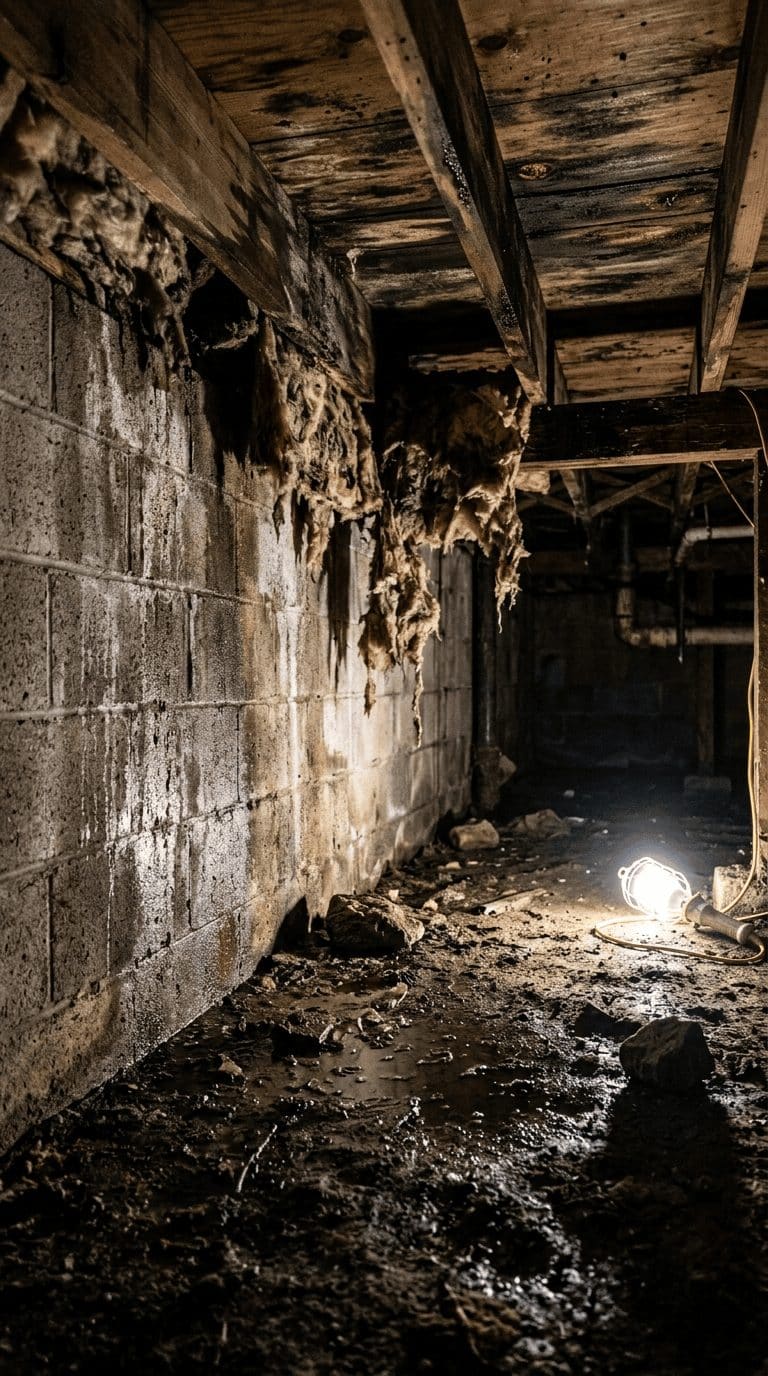
Nobody checks their crawl space on a Saturday morning. It is dark, it is low, and it is exactly where the spiders live. So crawl space problems almost never get noticed directly. They get noticed upstairs, as symptoms that seem unrelated until you know what to look for.
Here are the five we get called about most across Northeast Georgia.
1. A musty smell that keeps coming back
The classic. Up to half your first-floor air rises from the crawl space, so a damp, moldy space becomes a musty living room. If the smell returns no matter how much you clean, the source is probably below the floor, not on it.
2. Cupping or crowning hardwood floors
Wood moves with moisture. When the underside of a hardwood floor absorbs crawl space humidity while the top stays dry in the air conditioning, boards curl at the edges. Cupping floors are one of the most reliable signs of a moisture problem underneath, and one of the most expensive to ignore.
3. Cold floors in winter
If your feet can map which rooms sit over the crawl space in January, the insulation under the floor has probably fallen, slumped or soaked. Damp fiberglass sags out of its bays and stops insulating long before it hits the dirt.
4. Indoor humidity you cannot control
When the house feels muggy even with the air conditioning running, your HVAC may be fighting a crawl space that pushes humid air up through the floor around the clock. Sealing the source is one of the few fixes that shows up on both the comfort side and the power bill.
5. Bugs and critters moving in
Camel crickets, millipedes, mice, the occasional snake checking in like it owns a timeshare: pests love a dark, damp, undisturbed space with easy access through open vents. Recurring pest problems are often a crawl space problem wearing a costume.
One symptom is a hint. Two is a pattern.
Any one of these can have another explanation, which is why we never diagnose over the phone. But when two or more show up together, the crawl space is the first place to look. Our inspection is free, takes about an hour, and ends with photos and a straight answer: what we found, what it needs, and what it does not.
Recognize a couple of these? Try the symptom checker on our homepage, or skip ahead and book your free inspection.