
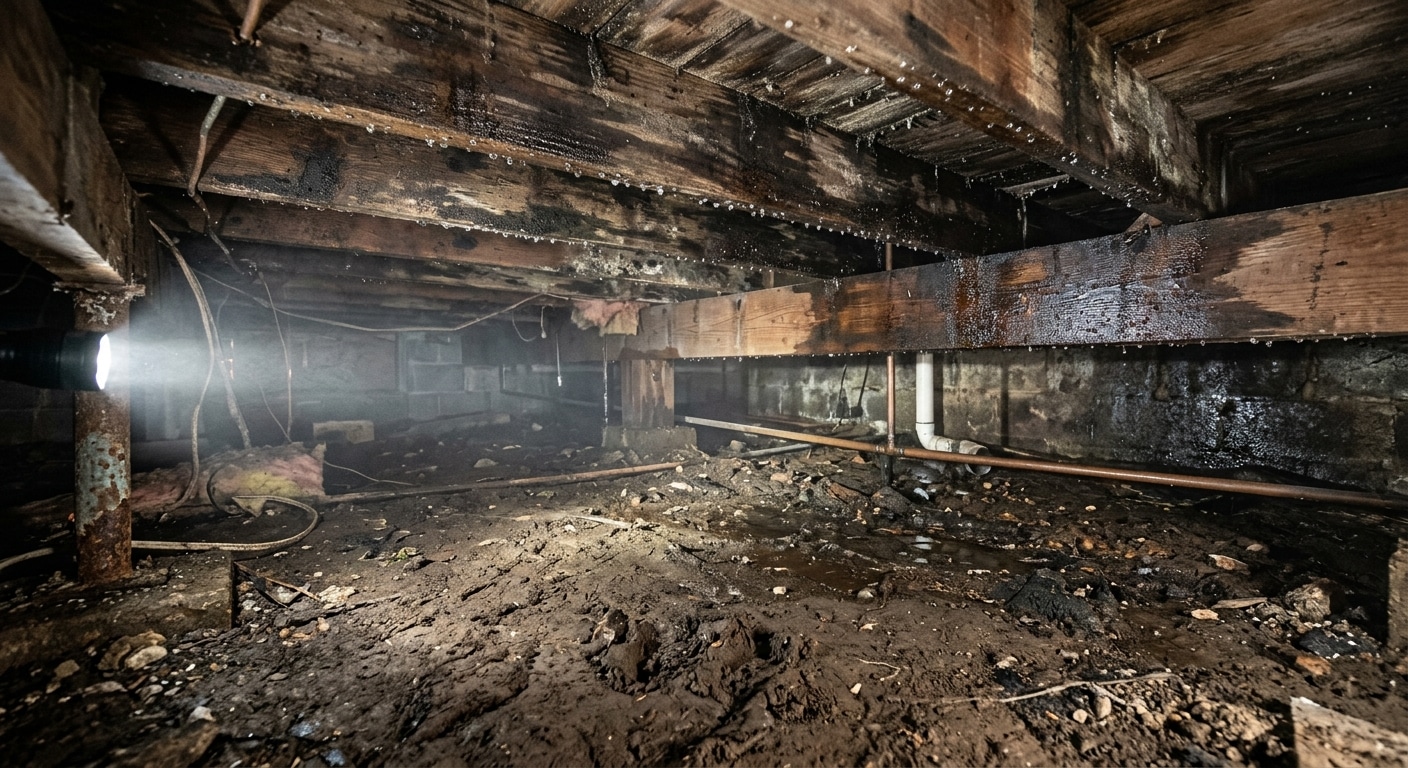
Most crawl space problems do not announce themselves until they are serious. By the time you see visible damage, the underlying moisture issue has usually been building for months or years.
These seven signs are what we find over and over when we inspect homes across the Athens, Gainesville, and Augusta areas. If you are seeing more than one of these, your crawl space deserves a look.
1. A Persistent Musty Smell Inside Your Home
This is the most common sign we hear about. Homeowners describe it as a basement-like smell, a damp earth smell, or just something that will not go away no matter how much they clean.
The smell comes from mold and organic decomposition in a moisture-loaded crawl space. Because air moves upward through a home (the stack effect), whatever is in your crawl space ends up in your living space. Musty air from below pushes up through gaps in floors, around plumbing penetrations, and through unsealed ductwork. If the smell is strongest near the floor or in rooms directly above the crawl space, it is almost certainly coming from below.
2. Higher Energy Bills Without a Clear Cause
Crawl space moisture affects energy efficiency in two ways. First, humid air is harder to cool. Your air conditioner removes heat AND moisture, so when humid air is constantly entering from below, your system works harder and runs longer. Second, moisture degrades insulation. Fiberglass insulation that has absorbed moisture loses a significant portion of its R-value.
If your energy bills have climbed over the last year or two without a change in behavior or equipment, the crawl space is a logical place to investigate.
3. Condensation or Moisture on Pipes and Surfaces
Visible condensation on ductwork, pipes, or the underside of your floor joists is a reliable sign that the crawl space air is holding too much moisture. When warm, humid crawl space air contacts a cooler surface, condensation forms. This is most noticeable in summer when the temperature differential is highest.
4. Soft or Springy Spots in Your Flooring
Floor joists that have absorbed moisture over time begin to lose structural integrity. As the wood softens, the floor above begins to flex. You might notice this as a section of floor that feels different underfoot, a spot where furniture legs sink slightly, or a creak that was not there before. These are structural symptoms of a crawl space that has been taking on moisture for an extended period.
5. Visible Mold or Dark Staining on Wood
If you have ever looked into your crawl space and seen black, green, or white growth on the wood joists or subfloor, that is mold. Mold on crawl space wood indicates that moisture conditions have been favorable for growth for an extended time. Mold must be treated before a liner goes in. Sealing mold under plastic does not stop it.
6. Pest Activity in the Crawl Space or Lower Level
Termites, carpenter ants, and wood-destroying insects are attracted to moisture-softened wood. A damp crawl space with exposed dirt and deteriorating wood is exactly the environment these pests seek. If you have had pest issues in the lower level of your home, moisture is likely part of the problem. Encapsulation removes the conditions that attract pests in the first place.
7. Condensation on Windows During Winter
In winter, if warm interior air is heavily loaded with moisture from the crawl space below, that moisture shows up as condensation on the inside surface of cold windows. If you see condensation on your interior window surfaces in winter and your home does not have other obvious sources of excess humidity, the crawl space is worth investigating.
What to Do If You Are Seeing These Signs
Any one of these signs is worth having looked at. Seeing two or more together strongly suggests a crawl space moisture problem that has been building for some time. The free inspection gives you a complete picture: moisture readings, photos, a specific diagnosis, and an honest recommendation.
FAQ: Crawl Space Moisture Problems
How do I know if I have a mold problem without going under?
The most reliable sign is the musty smell inside your home, particularly when HVAC systems are running. A professional inspection is the only way to get a definitive answer.
My crawl space has a vapor barrier already. Why am I still having issues?
A vapor barrier alone does not seal the space. It slows soil vapor but does not address wall condensation, vent-driven humidity, or standing water. Full encapsulation is a fundamentally different system.
Can I fix crawl space moisture myself?
Some minor issues can be addressed by homeowners (improving grading, clearing gutters, adding downspout extensions). Encapsulation itself requires commercial-grade materials and proper technique to work correctly.
See one or more of these signs in your Georgia home?
Schedule a free crawl space inspection with Crawl Space Doctors. We serve the Athens, Gainesville, and Augusta areas and surrounding communities. Call (678) 512-9201 or request an inspection online.